
braindecode.models.TCCNet#
- class braindecode.models.TCCNet(n_outputs=None, n_chans=None, chs_info=None, n_times=None, input_window_seconds=None, sfreq=None, filters=((32, 32), (32, 32), (64, 64), (128, )), kernel_size=3, drop_prob=0.05, activation=<class 'torch.nn.modules.activation.ReLU'>, classification_head='att', mask_value=-10.0)[source]#
TCCNet from Tsinganos et al. (2019) [tccnet2019].
Convolution Recurrent Attention/Transformer
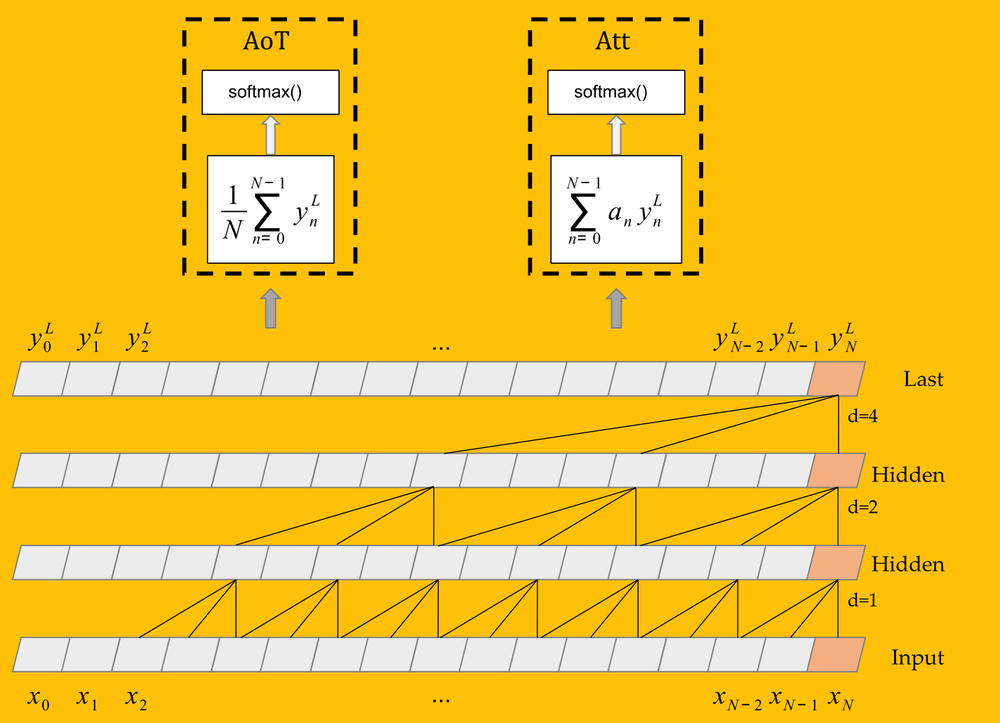
“Proposed model” panel of the authors’ ICASSP 2019 poster (MIT, from [tccnetcode]): dilated causal convolutions, read out by an average over time (AoT) or an attention (Att) head. Braindecode returns the logits, without the softmax.#
A temporal convolutional network that classifies a whole sEMG gesture. Residual blocks of causal convolutions, whose dilation doubles at every layer and keeps doubling across blocks, map the gesture to a sequence of features. An average over time (
"aot") or a context-vector attention ("att") pools that sequence into one vector for a linear classifier.The paper compares four models that differ in receptive field (RF) and head (poster Table 1; parameters counted for 10 channels and 53 classes):
Model
filtersConvs
Parameters
AoT, 300 ms
((32, 64), (64, 128))4
60,117
AoT, 2500 ms
((32, 32), (32, 32), (64, 64),
(128,))
7
72,245
Att, 300 ms
((32, 64), (64, 128))4
76,629
Att, 2500 ms
((32, 32), (32, 32), (64, 64),
(128,))
7
88,757
The defaults build Att, 2500 ms, the best model of the paper (89.76 % top-1). Pass
classification_head="aot"and/orfilters=((32, 64), (64, 128))for the other three. Withkernel_size=3, the RF is 31 samples (310 ms at 100 Hz) for the 4-convolution models and 255 samples (2550 ms) for the 7-convolution ones.Inputs are
(batch, n_chans, n_times)and may have any length. The softmax of the reference is left out, because braindecode models return logits.- Parameters:
n_outputs (int) – Number of outputs of the model. This is the number of classes in the case of classification.
n_chans (int) – Number of EEG channels.
chs_info (list of dict) – Information about each individual EEG channel. This should be filled with
info["chs"]. Refer tomne.Infofor more details.n_times (int) – Number of time samples of the input window.
input_window_seconds (float) – Length of the input window in seconds.
sfreq (float) – Sampling frequency of the EEG recordings.
filters (
Sequence[Sequence[int]]) – Output filters of each causal convolution, one inner sequence per residual block. It sets the number of blocks and of convolutions per block.kernel_size (
int) – Temporal kernel size of every causal convolution.drop_prob (
float) – Channel-wise dropout after each activated convolution, as KerasSpatialDropout1D.activation (
type[Module]) – Activation after each causal convolution.classification_head (
str) –"att": context-vector attention;"aot": average over the valid time steps.mask_value (
float|None) – A time step where every channel equals this value is padding: it is zeroed before every convolution and left out of the pooling, as the reference’s KerasMaskinglayer does.Noneturns masking off.
- Raises:
ValueError – If some input signal-related parameters are not specified: and can not be inferred.
Notes
Protocol of the reference code [tccnetcode], for all four models: one model per subject of NinaPro DB1 (27 subjects, 10 sEMG channels at 100 Hz, 53 classes including rest). Each channel is rectified and low-pass filtered by a 1 Hz first-order Butterworth filter applied forward-backward (
filtfilt). Each whole gesture repetition is one sample: the variable-length gestures of a batch are pre-padded with-10to the longest one and masked. Repetitions 1, 3, 4, 6, 8, 9 and 10 train; 2, 5 and 7 test. Training uses Adam (learning rate 0.01, epsilon 0.001) for 30 epochs, batch size 128, L2 0.0005 on convolution and classifier kernels (use optimizer weight decay in PyTorch), class- balanced sample weights, and 10 augmented copies of each training gesture (time and magnitude warping 0.2, noise at 25 dB SNR). The generator’s min-max normalisation is off in the released configurations.The masked average over time equals the reference only for pre-padding, the reference pipeline: the reference sums every time step, padded ones included, and divides by the number of valid steps, while this port always leaves padded steps out; on a fully padded input it gives NaN, as the reference does. The bias of each convolution is added only where the convolution output is non-zero, as in the reference
CausalConv1D; this only matters for bit-exact agreement with it. The attention subtracts the row maximum before the exponential: the same values as the reference, which overflows to NaN once the context vector grows large. Initialisation follows Keras 2.2.4: truncated Glorot normal kernels, zero biases, Glorot uniform attention weights.References
[tccnet2019]Tsinganos, P., Cornelis, B., Cornelis, J., Jansen, B., & Skodras, A. (2019). Improved Gesture Recognition Based on sEMG Signals and TCN. ICASSP 2019, 1169-1173. https://doi.org/10.1109/ICASSP.2019.8683239
Hugging Face Hub integration
When the optional
huggingface_hubpackage is installed, all models automatically gain the ability to be pushed to and loaded from the Hugging Face Hub. Install with:pip install braindecode[hub]
Pushing a model to the Hub:
from braindecode.models import TCCNet

# Train your model
model = TCCNet(n_chans=22, n_outputs=4, n_times=1000)
# ... training code ...

# Push to the Hub; ``datasets`` and ``base_model`` go to the card
model.push_to_hub(
    repo_id="username/my-tccnet-model",
    commit_message="Initial model upload",
    model_card_kwargs={"datasets": ["BNCI2014_001"]},
)
Loading a model from the Hub:
from braindecode.models import TCCNet

# Load pretrained model
model = TCCNet.from_pretrained("username/my-tccnet-model")
# Data the weights were trained on, from the Hub model card
print(model.card_data.datasets if model.card_data else None)

# Load with a different number of outputs (head is rebuilt automatically)
model = TCCNet.from_pretrained("username/my-tccnet-model", n_outputs=4)
Extracting features and replacing the head:
import torch

x = torch.randn(1, model.n_chans, model.n_times)
# Extract encoder features (consistent dict across all models)
out = model(x, return_features=True)
features = out["features"]

# Replace the classification head
model.reset_head(n_outputs=10)
Saving and restoring full configuration:
import json

config = model.get_config()            # all __init__ params
with open("config.json", "w") as f:
    json.dump(config, f)

model2 = TCCNet.from_config(config)    # reconstruct (no weights)
All model parameters (both EEG-specific and model-specific such as dropout rates, activation functions, number of filters) are automatically saved to the Hub and restored when loading.
See Loading and Adapting Pretrained Foundation Models for a complete tutorial.
Methods