
braindecode.models.EEGCLIP#
- class braindecode.models.EEGCLIP(n_outputs=None, n_chans=None, n_times=None, text_encoder=None, text_embedding_dim=768, eeg_encoder=None, eeg_embedding_dim=128, text_pooling='cls', projection_layers=3, activation=<class 'torch.nn.modules.activation.ReLU'>, drop_prob=0.1, initial_temperature=0.07, chs_info=None, input_window_seconds=None, sfreq=None)[source]#
Dual encoder for contrastive alignment of EEG and text [eegclip].
Foundation Model Convolution
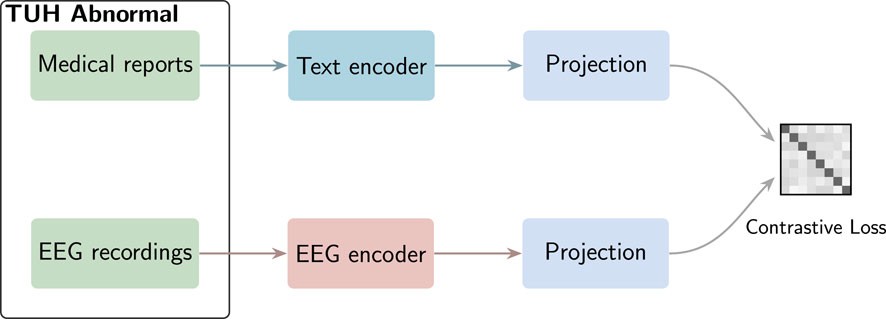
EEG-CLIP learns a shared embedding space for paired EEG recordings and clinical text reports with a symmetric contrastive objective. The default EEG encoder is a dense-prediction
Deep4Netwhose 128 log-softmax outputs per time step are projected and averaged over time, as in the authors’ code. The text encoder is anytorch.nn.Module(e.g. a Hugging Face ClinicalBERT, kept as an optional user dependency); withtext_encoder=Nonethe text inputs are precomputed features.forward(X)returns the projected EEG embeddings only, so the model keeps braindecode’s Tensor-valued contract. Train withforward_paired()andcontrastive_loss(); score zero-shot withcompute_logits()against embedded candidate descriptions.- Parameters:
n_outputs (int) – Number of outputs of the model. This is the number of classes in the case of classification.
n_chans (int) – Number of EEG channels.
n_times (int) – Number of time samples of the input window.
text_encoder (torch.nn.Module | None) – Text encoder called as
text_encoder(text_inputs, **kwargs). It returns a tensor, or a tuple / Hugging Face output whose first element is the tensor.Nonetreatstext_inputsas precomputed features.text_embedding_dim (int) – Dimension of the pooled text features.
eeg_encoder (torch.nn.Module | None) – EEG encoder returning
(batch, features)or(batch, features, time).Nonebuilds the default Deep4Net.eeg_embedding_dim (int) – Feature dimension of the EEG encoder output.
text_pooling ({"cls", "mean"}) – Pooling of token-sequence text outputs: first token, or the mean over tokens (masked when
attention_maskis given).projection_layers (int) – Linear layers in each projection head; 3 as in the paper.
activation (
type[Module]) – Activation of the non-final projection blocks.drop_prob (float) – Dropout probability of the non-final projection blocks.
initial_temperature (float) – The logit scale starts at
log(1 / initial_temperature)and, as in the authors’ code, multiplies the similarities withoutexp.chs_info (list of dict) – Information about each individual EEG channel. This should be filled with
info["chs"]. Refer tomne.Infofor more details.input_window_seconds (float) – Length of the input window in seconds.
sfreq (float) – Sampling frequency of the EEG recordings.
- Raises:
ValueError – If some input signal-related parameters are not specified: and can not be inferred.
Notes
n_outputsis the shared embedding dimension, not a number of classes. The releasedmodelsexample.ckptpredates the authors’ current projection head and is not loadable. Models with a customeeg_encoderortext_encodercannot be rebuilt from a config, soget_config()andsave_pretrainedraise for them; save theirstate_dict.The authors’ repository has no license file; this implementation follows braindecode’s BSD-3-Clause license, and its projection head mirrors the authors’ five-line
ProjectionHead.Examples
Train on paired EEG windows and precomputed text features:
import torch
from braindecode.models import EEGCLIP

model = EEGCLIP(
    n_chans=21, n_times=1000, n_outputs=64, text_embedding_dim=768
)
eeg_windows = torch.randn(2, 21, 1000)
text_features = torch.randn(2, 768)
paired = model.forward_paired(eeg_windows, text_features)
loss = model.contrastive_loss(
    paired["eeg_embeds"], paired["text_embeds"]
)
References
[eegclip]N’dir, T. C., Schirrmeister, R. T., & Ball, T. (2025). EEG-CLIP: Learning EEG representations from natural language descriptions. Frontiers in Robotics and AI, 12, 1625731. https://doi.org/10.3389/frobt.2025.1625731
Added in version 1.9.
Hugging Face Hub integration
When the optional
huggingface_hubpackage is installed, all models automatically gain the ability to be pushed to and loaded from the Hugging Face Hub. Install with:pip install braindecode[hub]
Pushing a model to the Hub:
from braindecode.models import EEGCLIP

# Train your model
model = EEGCLIP(n_chans=22, n_outputs=4, n_times=1000)
# ... training code ...

# Push to the Hub
model.push_to_hub(
    repo_id="username/my-eegclip-model",
    commit_message="Initial model upload",
)
Loading a model from the Hub:
from braindecode.models import EEGCLIP

# Load pretrained model
model = EEGCLIP.from_pretrained("username/my-eegclip-model")

# Load with a different number of outputs (head is rebuilt automatically)
model = EEGCLIP.from_pretrained("username/my-eegclip-model", n_outputs=4)
Extracting features and replacing the head:
import torch

x = torch.randn(1, model.n_chans, model.n_times)
# Extract encoder features (consistent dict across all models)
out = model(x, return_features=True)
features = out["features"]

# Replace the classification head
model.reset_head(n_outputs=10)
Saving and restoring full configuration:
import json

config = model.get_config()            # all __init__ params
with open("config.json", "w") as f:
    json.dump(config, f)

model2 = EEGCLIP.from_config(config)    # reconstruct (no weights)
All model parameters (both EEG-specific and model-specific such as dropout rates, activation functions, number of filters) are automatically saved to the Hub and restored when loading.
See Loading and Adapting Pretrained Foundation Models for a complete tutorial.
Methods
- compute_logits(eeg_embeds, text_embeds)[source]#
Return EEG-to-text and text-to-EEG similarity logits.
As in the authors’
ClipLoss, embeddings are not L2-normalized and the rawlogit_scalemultiplies the dot products.- Parameters:
eeg_embeds – The description is missing.
text_embeds – The description is missing.
- contrastive_loss(eeg_embeds, text_embeds)[source]#
Symmetric cross-entropy over a batch of paired EEG/text embeddings.
- Parameters:
eeg_embeds – The description is missing.
text_embeds – The description is missing.
- encode_text(text_inputs, attention_mask=None, **text_kwargs)[source]#
Encode text tokens or features as shared-space projection vectors.
- Parameters:
text_inputs – The description is missing.
attention_mask – The description is missing.
**text_kwargs – The description is missing.
- forward(X)[source]#
Return projected EEG embeddings, shape
(batch, n_outputs).- Parameters:
X – The description is missing.
- forward_paired(X, text_inputs, attention_mask=None, **text_kwargs)[source]#
Return paired EEG/text embeddings and bidirectional similarity logits.
- Parameters:
X – The description is missing.
text_inputs – The description is missing.
attention_mask – The description is missing.
**text_kwargs – The description is missing.
- get_config()[source]#
Return the config; custom encoders cannot be rebuilt from one.
- Returns:
All
__init__parameters, JSON-serializable.type[nn.Module]parameters (e.g.activation) are encoded as importable dotted-path strings.- Return type:
Examples
>>> import json
>>> from braindecode.models import EEGNet
>>> model = EEGNet(n_chans=22, n_times=1000, n_outputs=4, F1=16)
>>> config = model.get_config()
>>> config["F1"]
16
>>> # Save to disk
>>> with open("config.json", "w") as f:
...     json.dump(config, f)
Added in version 1.4.
- reset_head(n_outputs)[source]#
Rebuild both projection heads for a new shared embedding dimension.
- Parameters:
n_outputs (int) – New number of output classes.
Examples
>>> from braindecode.models import BENDR
>>> model = BENDR(n_chans=22, n_times=1000, n_outputs=4)
>>> model.reset_head(10)
>>> model.n_outputs
10
Added in version 1.4.