
braindecode.models.EpiNT#
- class braindecode.models.EpiNT(patch_size=256, embed_dim=512, n_layers=6, n_heads=8, ffn_dim=2048, drop_prob=0.1, head_drop_prob=0.1, rope_theta=10000.0, activation=<class 'torch.nn.modules.activation.ReLU'>, n_outputs=None, n_chans=None, chs_info=None, n_times=None, input_window_seconds=None, sfreq=None, channel_strategy='native', channel_strategy_kwargs=None)[source]#
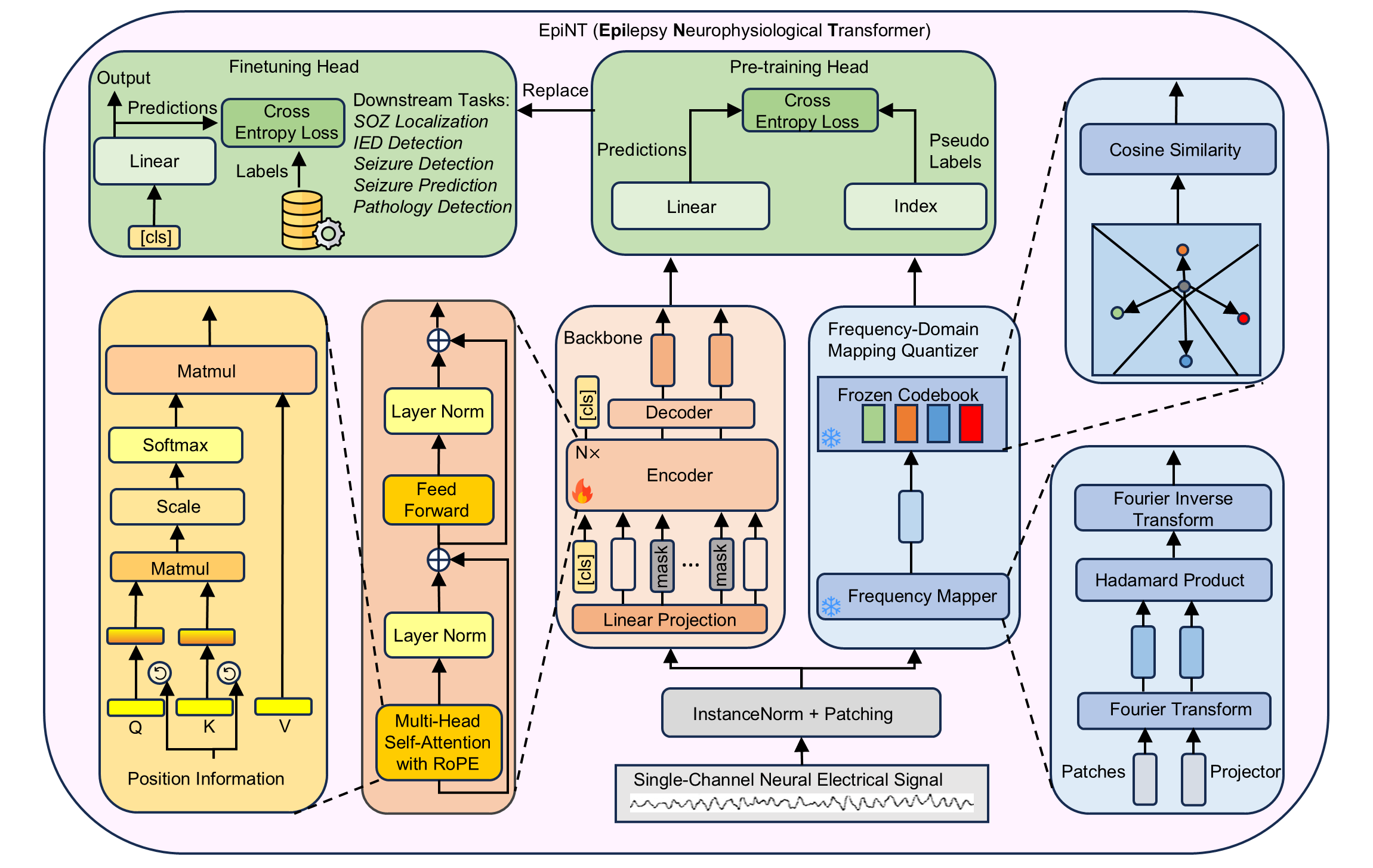
EpiNT from Zhang et al. (2025) [EpiNT2025].
Foundation Model Attention/Transformer
Added in version 1.9.
EpiNT (Epilepsy Neurophysiological Transformer) is pretrained on 2,700 hours of scalp EEG and intracranial EEG (ECoG, sEEG) from 1,199 patients. It is channel independent: every channel is encoded alone, so one checkpoint serves any montage and modality.
Architecture Overview
instance_normz-scores each channel over time (affine, one scale and one offset shared by all channels).patch_embeddingprojects non-overlapping patches ofpatch_sizesamples toembed_dim, and a learnedcls_tokenis prepended.encoderis a stack of post-norm Transformer layers with rotary position embeddings (RoPE) in the self-attention. As upstream, eachLayerNormspans the token and feature axes, so the number of patches (n_times // patch_size) is fixed at construction.The class token of each channel is averaged over channels and
final_layer(dropout and one linear layer) classifies it.
The pretraining mask token and frequency-domain mapping quantizer are not used downstream, so they are not part of this module.
- Parameters:
patch_size (
int) – Samples per patch. Default 256.embed_dim (
int) – Transformer width. Default 512.n_layers (
int) – Number of Transformer layers. Default 6.n_heads (
int) – Number of attention heads;embed_dim // n_headsmust be even for RoPE. Default 8.ffn_dim (
int) – Inner dimension of the feed-forward blocks. Default 2048.drop_prob (
float) – Dropout in the Transformer layers. Default 0.1.head_drop_prob (
float) – Dropout beforefinal_layer. Default 0.1.rope_theta (
float) – RoPE base frequency. Default 10000.activation (
type[Module]) – Feed-forward activation. Defaultnn.ReLU, as pretrained.n_outputs (int) – Number of outputs of the model. This is the number of classes in the case of classification.
n_chans (int) – Number of EEG channels.
chs_info (list of dict) – Information about each individual EEG channel. This should be filled with
info["chs"]. Refer tomne.Infofor more details.n_times (int) – Number of time samples of the input window.
input_window_seconds (float) – Length of the input window in seconds.
sfreq (float) – Sampling frequency of the EEG recordings.
channel_strategy (
str) – How any montage reaches the backbone (pretrained models only; see Channel strategies: any montage in)."native"keeps the model as it is."exact","zero","nearest","idw","spline","field","source","region","wiener"(callmodel.channel_layer.fitfirst) or"latent"map the montage ofchs_info(or of thechs_infogiven toforward) onto the backbone’s channels with aChannelLayer. Saved in the config.model(x)andmodel.forward(x)both apply the layer.channel_strategy_kwargs (
dict|None) – Options of the strategy (e.g.{"reg": 1e-2}for"spline").
- Raises:
ValueError – If some input signal-related parameters are not specified: and can not be inferred.
Notes
Input. The pretrained weights expect
n_times=3072: 12 s at 256 Hz (scalp EEG) or 3 s at 1024 Hz (iEEG), in microvolts as the authors prepare them (instance_normhaseps=1e-5, so signals in volts are not scaled to unit variance). The authors classify single-channel samples (n_chans=1).Weights. The authors’ weights are plain files in their repository, not a release (License):
weights/representations.bin(the pretrained backbone) andweights/finetune_on_MAYO.bin(a linear probe of it on MAYO). Both load throughmapping, the probe withstrict=True:state = torch.load("representations.bin", map_location="cpu") model = EpiNT(n_chans=1, n_outputs=2, n_times=3072) model.load_state_dict(state, strict=False) # no head, mask token unused
The authors’ fine-tuning code at the time of the paper applies the cross-entropy to softmax outputs (changed upstream in August 2025); with it and seed 0 their code trains a MAYO probe with the scores of
finetune_on_MAYO.bin(F1 0.916, accuracy 0.851).Replication. With the released weights, the port matches the authors’ code within float rounding (logits within 1.4e-6 in float32). Fine-tuned with the authors’ protocol, the three MAYO cells of Table 3 (the authors’ test patients) are within 3 % of the paper. Linear probing on CHB-MIT and FNUSA gives 0.73-0.76 with both the port and the authors’ code (paper: 0.857 and 0.805); the paper does not publish its test patients for these two datasets or the runs behind its mean ± std.
References
[EpiNT2025]Zhang, R., Yu, H., Gan, J. Q. and Wang, H., 2025. Cross-modal epileptic signal harmonization: Frequency domain mapping quantization for pre-training a unified neurophysiological transformer. arXiv:2506.17068. Code: https://github.com/RunKZhang/EpiNT
Hugging Face Hub integration
When the optional
huggingface_hubpackage is installed, all models automatically gain the ability to be pushed to and loaded from the Hugging Face Hub. Install with:pip install braindecode[hub]
Pushing a model to the Hub:
from braindecode.models import EpiNT

# Train your model
model = EpiNT(n_chans=22, n_outputs=4, n_times=1000)
# ... training code ...

# Push to the Hub
model.push_to_hub(
    repo_id="username/my-epint-model",
    commit_message="Initial model upload",
)
Loading a model from the Hub:
from braindecode.models import EpiNT

# Load pretrained model
model = EpiNT.from_pretrained("username/my-epint-model")

# Load with a different number of outputs (head is rebuilt automatically)
model = EpiNT.from_pretrained("username/my-epint-model", n_outputs=4)
Extracting features and replacing the head:
import torch

x = torch.randn(1, model.n_chans, model.n_times)
# Extract encoder features (consistent dict across all models)
out = model(x, return_features=True)
features = out["features"]

# Replace the classification head
model.reset_head(n_outputs=10)
Saving and restoring full configuration:
import json

config = model.get_config()            # all __init__ params
with open("config.json", "w") as f:
    json.dump(config, f)

model2 = EpiNT.from_config(config)    # reconstruct (no weights)
All model parameters (both EEG-specific and model-specific such as dropout rates, activation functions, number of filters) are automatically saved to the Hub and restored when loading.
See Loading and Adapting Pretrained Foundation Models for a complete tutorial.
Methods
- forward(x, return_features=False)[source]#
Classify a batch of signals.
- Parameters:
- Returns:
Logits of shape
(batch, n_outputs), or the feature dict.- Return type:
torch.Tensor or dict
- reset_head(n_outputs)[source]#
Replace the classification head for a new number of outputs.
This is called automatically by
from_pretrained()when the user passes ann_outputsthat differs from the saved config. Override in subclasses that need a model-specific head structure. Implementations keep changed constructor arguments in sync withself._update_init_kwargs, so that a saved model can be loaded back. Implementations requiring positive outputs can also useself._set_n_outputsto validate and record the new value.Examples
>>> from braindecode.models import BENDR
>>> model = BENDR(n_chans=22, n_times=1000, n_outputs=4)
>>> model.reset_head(10)
>>> model.n_outputs
10
Added in version 1.4.