
braindecode.models.SleepStagerBlanco2020#
- class braindecode.models.SleepStagerBlanco2020(n_chans=None, sfreq=None, n_conv_chans=20, input_window_seconds=None, n_outputs=5, n_groups=2, max_pool_size=2, drop_prob=0.5, apply_batch_norm=False, return_feats=False, activation=<class 'torch.nn.modules.activation.ReLU'>, chs_info=None, n_times=None)[source]#
Sleep staging architecture from Blanco et al (2020) from [Blanco2020]
Convolution
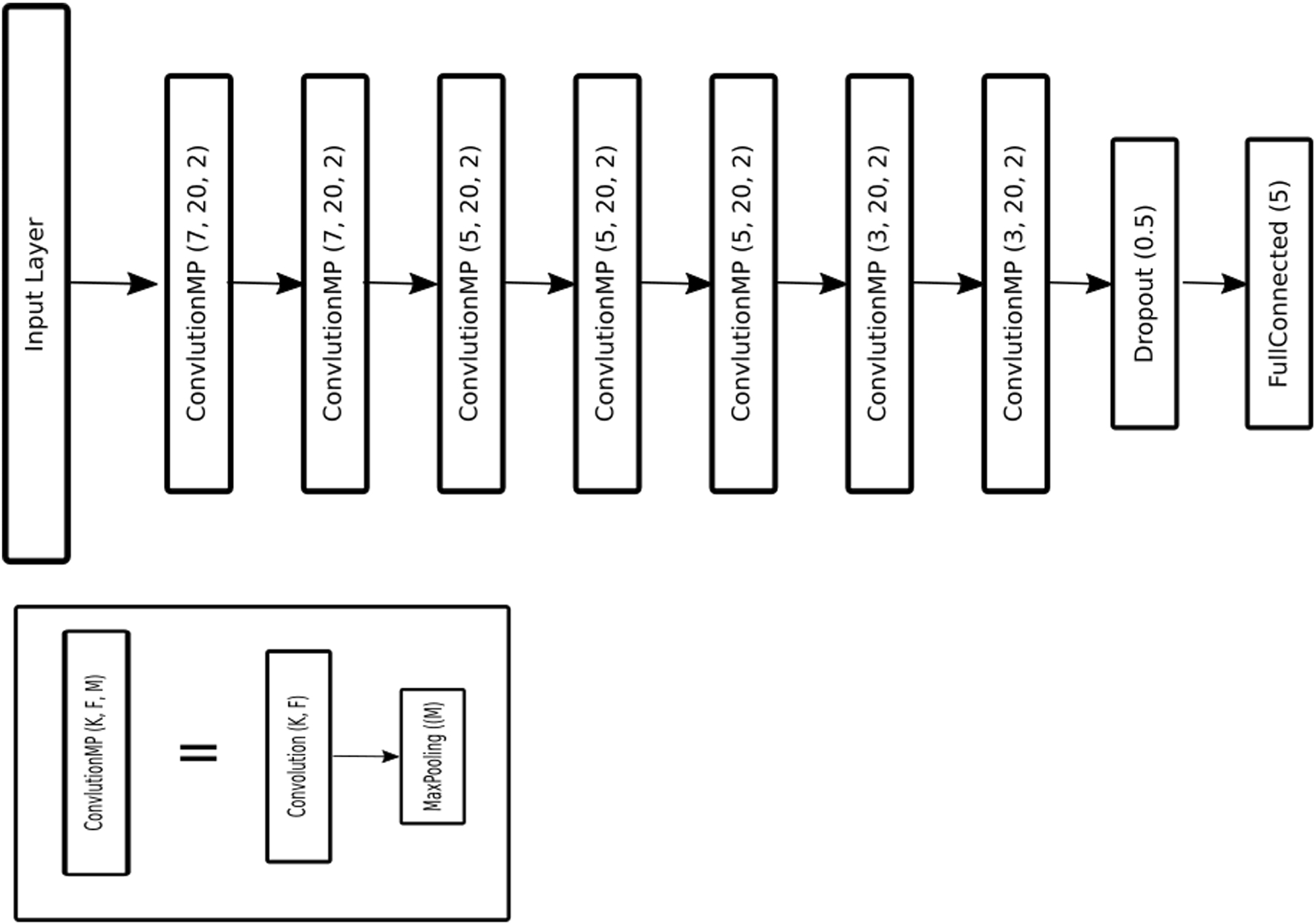
Convolutional neural network for sleep staging described in [Blanco2020]. A series of seven convolutional layers with kernel sizes running down from 7 to 3, in an attempt to extract more general features at the beginning, while more specific and complex features were extracted in the final stages.
- Parameters:
n_chans (int) – Number of EEG channels.
sfreq (float) – Sampling frequency of the EEG recordings.
n_conv_chans (int) – Number of convolutional channels. Set to 20 in [Blanco2020].
input_window_seconds (float) – Length of the input window in seconds.
n_outputs (int) – Number of outputs of the model. This is the number of classes in the case of classification.
n_groups (int) – Number of groups for the convolution. Set to 2 in [Blanco2020] for 2 Channel EEG. Controls the connections between inputs and outputs.
n_chansandn_conv_chansmust be divisible byn_groups.max_pool_size (int, default=2) – Kernel and stride of the max pooling layers.
drop_prob (float) – Dropout rate before the output dense layer.
apply_batch_norm (bool) – If True, apply batch normalization after both temporal convolutional layers.
return_feats (bool) – If True, return the features, i.e. the output of the feature extractor (before the final linear layer). If False, pass the features through the final linear layer.
activation (
type[Module]) – Activation function class to apply. Should be a PyTorch activation module class likenn.ReLUornn.ELU. Default isnn.ReLU.chs_info (list of dict) – Information about each individual EEG channel. This should be filled with
info["chs"]. Refer tomne.Infofor more details.n_times (int) – Number of time samples of the input window.
- Raises:
ValueError – If some input signal-related parameters are not specified: and can not be inferred.
Notes
If some input signal-related parameters are not specified, there will be an attempt to infer them from the other parameters.
References
[Blanco2020] (1,2,3,4)Fernandez-Blanco, E., Rivero, D. & Pazos, A. Convolutional neural networks for sleep stage scoring on a two-channel EEG signal. Soft Comput 24, 4067–4079 (2020). https://doi.org/10.1007/s00500-019-04174-1
Hugging Face Hub integration
When the optional
huggingface_hubpackage is installed, all models automatically gain the ability to be pushed to and loaded from the Hugging Face Hub. Install with:pip install braindecode[hub]
Pushing a model to the Hub:
from braindecode.models import SleepStagerBlanco2020

# Train your model
model = SleepStagerBlanco2020(n_chans=22, n_outputs=4, n_times=1000)
# ... training code ...

# Push to the Hub
model.push_to_hub(
    repo_id="username/my-sleepstagerblanco2020-model",
    commit_message="Initial model upload",
)
Loading a model from the Hub:
from braindecode.models import SleepStagerBlanco2020

# Load pretrained model
model = SleepStagerBlanco2020.from_pretrained("username/my-sleepstagerblanco2020-model")

# Load with a different number of outputs (head is rebuilt automatically)
model = SleepStagerBlanco2020.from_pretrained("username/my-sleepstagerblanco2020-model", n_outputs=4)
Extracting features and replacing the head:
import torch

x = torch.randn(1, model.n_chans, model.n_times)
# Extract encoder features (consistent dict across all models)
out = model(x, return_features=True)
features = out["features"]

# Replace the classification head
model.reset_head(n_outputs=10)
Saving and restoring full configuration:
import json

config = model.get_config()            # all __init__ params
with open("config.json", "w") as f:
    json.dump(config, f)

model2 = SleepStagerBlanco2020.from_config(config)    # reconstruct (no weights)
All model parameters (both EEG-specific and model-specific such as dropout rates, activation functions, number of filters) are automatically saved to the Hub and restored when loading.
See Loading and Adapting Pretrained Foundation Models for a complete tutorial.
Methods
- forward(x)[source]#
Forward pass.
- Parameters:
x (torch.Tensor) – Batch of EEG windows of shape (batch_size, n_channels, n_times).