
braindecode.models.SensingDynamics#
- class braindecode.models.SensingDynamics(n_outputs=None, n_chans=None, chs_info=None, n_times=None, input_window_seconds=None, sfreq=None, *, temporal_channels=256, mid_channels=32, spatial_channels=64, mlp_hidden=512, drop_prob=0.25, mlp_drop_prob=0.4, lowpass_hz=20.0, lowpass_order=4, temporal_kernel=(1, 31), temporal_stride=(1, 8), mid_kernel=(8, 18), mid_dilation=(2, 1), spatial_kernel=(3, 1), electrode_wrap=4, activation=<class 'braindecode.modules.activation.SmoothMaximumUnit'>)[source]#
SensingDynamics from Sîmpetru et al. (2022) [simpetru2022].
Convolution Channel
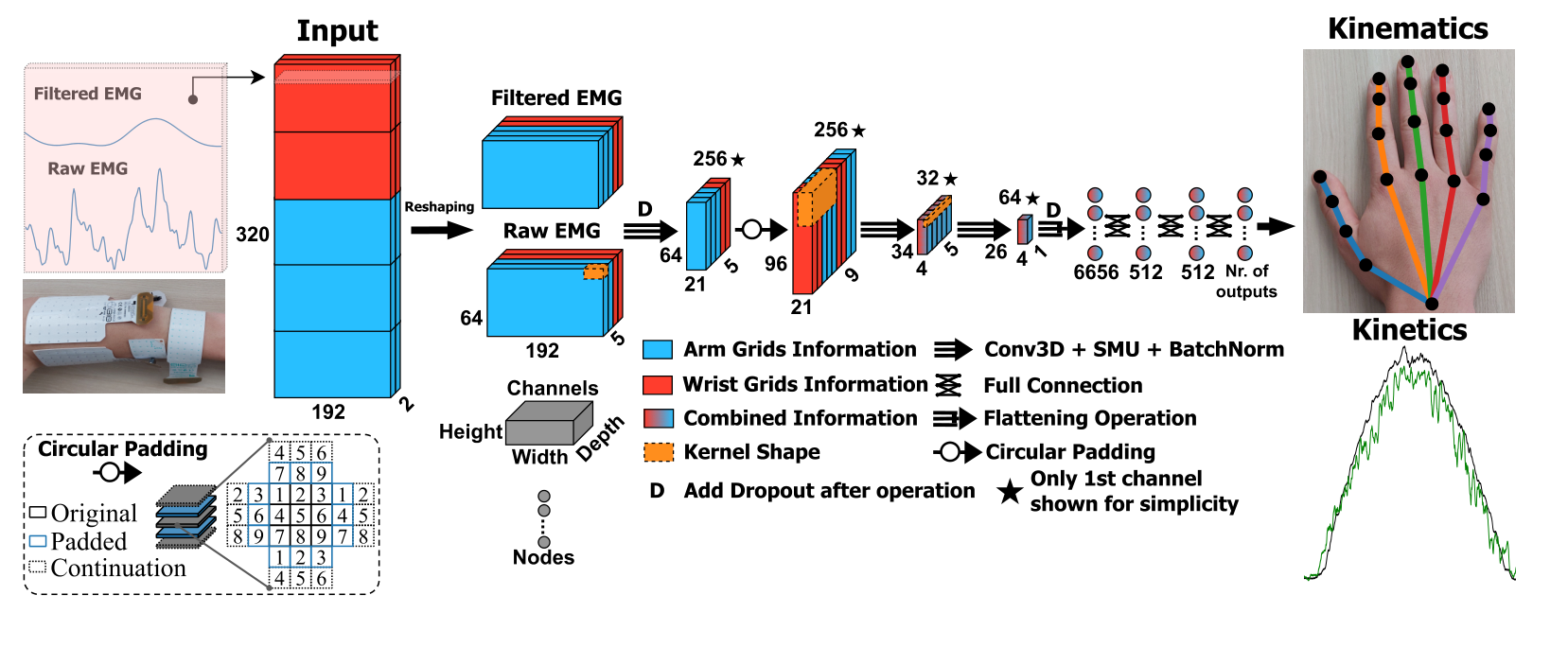
Figure 7 of Sîmpetru et al. (2022), CC BY-ND. Raw and low-pass filtered sEMG enter stacked, the electrode axis is circularly padded, and a 512/512 MLP reads out the joint angles.#
Architecture Overview
The emg2pose adaptation replaces the original five-grid 3D convolutions with 2D convolutions over the 16 wristband electrodes and time. Dividing the original spatial geometry by four preserves its relative receptive field. The network directly regresses joint angles.
Macro Components
SensingDynamics.lowpass(spectral input copy)Operations. Periodic fourth-order, zero-phase 20 Hz Butterworth response. Role. Exposes the low-frequency neural drive alongside broadband monopolar EMG.
SensingDynamics.conv1(action-potential detector)Operations. Conv2d
(1, 31), stride(1, 8), BatchNorm, SMU, and spatial dropout. Role. Detects short motor-unit waveform patterns independently at each electrode.SensingDynamics.conv2/SensingDynamics.conv3(ring mixer)Operations. Circular padding by four electrodes; dilated Conv2d
(8, 18)with dilation(2, 1); Conv2d(3, 1); BatchNorm and SMU after both convolutions. Role. Mixes synchronous activity around the wristband with a 17-electrode spatial and 167-sample temporal receptive field.SensingDynamics.mlp/SensingDynamics.final_layerOperations. Flatten the 64 by 8 spatial features with an einops layer, then apply a
512, 512, n_outputsMLP. Role. Regresses joint angles at the feature rate before linear interpolation to the input grid.
Temporal, Spatial, and Spectral Encoding
Time: valid temporal kernels cover 167 input samples and stride by 8.
Channels/space: circular padding respects the wristband topology.
Frequency: broadband EMG is depth-stacked with a 20 Hz low-pass copy.
Additional Mechanisms
SMU keeps its published fixed
alpha=0.01and independently learnablemu=2.5initialization. The source paper’s 150 ms output moving average is postprocessing and is not part of this neural-network module. Pass an externally filtered tensor asx_lowpassto reproduce a particular historical filter’s boundary handling exactly. The emg2pose benchmark reports a 10,167-sample training window for this baseline; it does not publish how the adapted network assigns its 167-sample receptive field between target alignment and window context.Note
The emg2pose paper specifies that kernels, strides, and dilations were changed to preserve the original receptive fields, but its public code and checkpoint omit SensingDynamics. The 16-channel spatial dimensions in this implementation are consequently derived from that published rule; exact checkpoint equivalence cannot be asserted without the unreleased implementation.
Added in version 1.8.
- Parameters:
n_outputs (int) – Number of outputs of the model. This is the number of classes in the case of classification.
n_chans (int) – Number of EEG channels.
chs_info (list of dict) – Information about each individual EEG channel. This should be filled with
info["chs"]. Refer tomne.Infofor more details.n_times (int) – Number of time samples of the input window.
input_window_seconds (float) – Length of the input window in seconds.
sfreq (float) – Sampling frequency of the EEG recordings.
temporal_channels (
int) – Output width of the action-potential detector. Default is256.mid_channels (
int) – Output width of the dilated electrode mixer. Default is32.spatial_channels (
int) – Output width of the final convolution. Default is64.mlp_hidden (
int) – Width of both hidden MLP layers. Default is512.drop_prob (
float) – Spatial dropout after the first convolution. Default is0.25.mlp_drop_prob (
float) – Dropout before the MLP. Default is0.4.lowpass_hz (
float) – Cutoff of the Butterworth input copy. Default is20.lowpass_order (
int) – Order of that Butterworth filter. Default is4.temporal_kernel (
tuple[int,int]) –(electrodes, time)kernel of the action-potential detector. Default is(1, 31).temporal_stride (
tuple[int,int]) – Stride of that convolution. Default is(1, 8).mid_kernel (
tuple[int,int]) –(electrodes, time)kernel of the electrode mixer. Default is(8, 18).mid_dilation (
tuple[int,int]) – Dilation of the mixer. Default is(2, 1).spatial_kernel (
tuple[int,int]) –(electrodes, time)kernel of the final convolution. Default is(3, 1).electrode_wrap (
int) – Circular padding applied to each end of the electrode axis, which is a ring on the wristband. Default is4.activation (
type[Module]) – Activation class. The default is the paper’s learnable SMU.
- Raises:
ValueError – If some input signal-related parameters are not specified: and can not be inferred.
Notes
If some input signal-related parameters are not specified, there will be an attempt to infer them from the other parameters.
References
[simpetru2022]Sîmpetru, Arkudas, Braun, Osswald, Oliveira, Eskofier, Kinfe, Del Vecchio (2022). Sensing the Full Dynamics of the Human Hand with a Neural Interface and Deep Learning. bioRxiv 2022.07.29.502064. doi:10.1101/2022.07.29.502064
Hugging Face Hub integration
When the optional
huggingface_hubpackage is installed, all models automatically gain the ability to be pushed to and loaded from the Hugging Face Hub. Install with:pip install braindecode[hub]
Pushing a model to the Hub:
from braindecode.models import SensingDynamics

# Train your model
model = SensingDynamics(n_chans=22, n_outputs=4, n_times=1000)
# ... training code ...

# Push to the Hub; ``datasets`` and ``base_model`` go to the card
model.push_to_hub(
    repo_id="username/my-sensingdynamics-model",
    commit_message="Initial model upload",
    model_card_kwargs={"datasets": ["BNCI2014_001"]},
)
Loading a model from the Hub:
from braindecode.models import SensingDynamics

# Load pretrained model
model = SensingDynamics.from_pretrained("username/my-sensingdynamics-model")
# Data the weights were trained on, from the Hub model card
print(model.card_data.datasets if model.card_data else None)

# Load with a different number of outputs (head is rebuilt automatically)
model = SensingDynamics.from_pretrained("username/my-sensingdynamics-model", n_outputs=4)
Extracting features and replacing the head:
import torch

x = torch.randn(1, model.n_chans, model.n_times)
# Extract encoder features (consistent dict across all models)
out = model(x, return_features=True)
features = out["features"]

# Replace the classification head
model.reset_head(n_outputs=10)
Saving and restoring full configuration:
import json

config = model.get_config()            # all __init__ params
with open("config.json", "w") as f:
    json.dump(config, f)

model2 = SensingDynamics.from_config(config)    # reconstruct (no weights)
All model parameters (both EEG-specific and model-specific such as dropout rates, activation functions, number of filters) are automatically saved to the Hub and restored when loading.
See Loading and Adapting Pretrained Foundation Models for a complete tutorial.
Methods
- forward(x, x_lowpass=None)[source]#
Predict angles, optionally using an externally filtered input copy.