

Note
Go to the end to download the full example code.
Seizure alarm on CHB-MIT, scored with SzCORE#
This tutorial trains a seizure detector on two patients of the CHB-MIT Scalp
EEG Database [1] and tests it on a third patient, so the model never sees the
test patient. A causal post-processing turns the window scores into alarms.
braindecode.training.szcore_event_scores() then scores the alarms with the
event-based SzCORE rules [2], and we report sensitivity and false alarms per hour.
We read seven EDF files (about 250 MB) directly from PhysioNet. We do not use
braindecode.datasets.CHBMIT, which downloads a 21.7 GB BIDS archive.
# Authors: Aayushya Patel <67443596+ptlnextdoor@users.noreply.github.com>
#
# License: BSD (3-clause)
Download the recordings#
Each record has a known SHA-256 hash, so pooch downloads it once and
checks it. The seizure times, in seconds from the start of each record, come
from the chbNN-summary.txt files of the database. Patients chb01 and
chb02 train the model and patient chb05 tests it.
from pathlib import Path

import mne
import pooch

URL = "https://physionet.org/files/chbmit/1.0.0"
CACHE = Path(mne.get_config("MNE_DATA", "~/mne_data")).expanduser() / "chbmit"

# record: (seizure onset, seizure offset, SHA-256)
TRAIN = {
    "chb01_18": (1720, 1810, "da6c386c78d6f8348b38886b90bf67e4dc2e6f26e5eb657c1920d612fc0651b5"),
    "chb01_21": (327, 420, "ceb3e5c3e6d513ed8894d6d5d5fd4599c5650e98a1a1c960660b0031b720e559"),
    "chb01_26": (1862, 1963, "c70832d28f4e2905e5f0179fdb7d5ec24c4f24006adf6a9905b60072a75cc630"),
    "chb02_16": (130, 212, "b50345b4b7d35d2735e3d2fc5f7df3e39a60916a881a11f2cd40337e529ea3fa"),
}  # fmt: skip
TEST = {
    "chb05_06": (417, 532, "8a15d8871289ff5947136c2bbd4482af9a9ac30d402efd3357993b064e86a2fd"),
    "chb05_13": (1086, 1196, "2691a118f880811b0c74b9314bbae7a659870325932c32a08b0a569f5ff29a81"),
    "chb05_16": (2317, 2413, "9a608a87f85378a59cd149d26addf2946e334148380d955e710fd3eb14341074"),
}  # fmt: skip


def fetch(record, sha256):
    return pooch.retrieve(
        f"{URL}/{record[:5]}/{record}.edf",
        known_hash=f"sha256:{sha256}",
        fname=f"{record}.edf",
        path=CACHE,
    )
Load and preprocess#
We keep the 18 bipolar channels of the longitudinal montage that all three
patients share. MNE renames the duplicated T8-P8 channel to T8-P8-0
and T8-P8-1, so we read the whole file and then pick the channels.
A seizure is rare, so we train on the seizure plus 300 s on each side of it, and we keep the test records whole: counting false alarms per hour needs every hour. We resample to 128 Hz and convert volts to microvolts.
from braindecode.datasets import BaseConcatDataset, RawDataset

CHANNELS = [
    "FP1-F7", "F7-T7", "T7-P7", "P7-O1", "FP1-F3", "F3-C3", "C3-P3", "P3-O1",
    "FP2-F4", "F4-C4", "C4-P4", "P4-O2", "FP2-F8", "F8-T8", "T8-P8-0", "P8-O2",
    "FZ-CZ", "CZ-PZ",
]  # fmt: skip
SFREQ = 128
MARGIN_S = 300


def load(record, onset, offset, sha256, crop):
    raw = mne.io.read_raw_edf(fetch(record, sha256), preload=True, verbose="error")
    raw.pick(CHANNELS)
    if crop:
        tmin = max(0, onset - MARGIN_S)
        raw.crop(tmin, min(offset + MARGIN_S, raw.times[-1]))
        onset, offset = onset - tmin, offset - tmin
    raw.resample(SFREQ)
    raw.apply_function(lambda x: x * 1e6)
    # One annotation per stretch, so that the windower can sample each class.
    stretches = [
        ("background", 0, onset),
        ("seizure", onset, offset),
        ("background", offset, raw.times[-1]),
    ]
    stretches = [(d, a, b) for d, a, b in stretches if b > a]
    raw.set_annotations(
        mne.Annotations(
            onset=[a for _, a, _ in stretches],
            duration=[b - a for _, a, b in stretches],
            description=[d for d, _, _ in stretches],
        )
    )
    return RawDataset(raw, {"record": record})


train_set = BaseConcatDataset([load(r, *v, crop=True) for r, v in TRAIN.items()])
test_set = {r: load(r, *v, crop=False) for r, v in TEST.items()}
Training windows#
We cut 4 s windows. The stride differs per class: 1 s inside a seizure and 5 s in the background, which balances the classes in the training set.
from braindecode.preprocessing import create_windows_from_events

train_windows = create_windows_from_events(
    train_set,
    window_size_samples=4 * SFREQ,
    window_stride_samples={"seizure": SFREQ, "background": 5 * SFREQ},
    mapping={"background": 0, "seizure": 1},
    on_last_window="drop",
    preload=True,
)
labels = [y for _, y, _ in train_windows]
print(f"{len(labels)} training windows, {sum(labels)} of them in a seizure")
800 training windows, 354 of them in a seizure
Train a model#
braindecode.models.ShallowFBCSPNet is a small convolutional network
that trains in seconds on a CPU. We train it for 15 epochs and do not tune it,
because the tutorial focuses on the scoring.
import torch

from braindecode import EEGClassifier
from braindecode.models import ShallowFBCSPNet
from braindecode.util import set_random_seeds

set_random_seeds(seed=0, cuda=False)
clf = EEGClassifier(
    ShallowFBCSPNet,
    module__n_chans=len(CHANNELS),
    module__n_outputs=2,
    module__n_times=4 * SFREQ,
    module__final_conv_length="auto",
    optimizer=torch.optim.AdamW,
    optimizer__lr=1e-3,
    batch_size=64,
    max_epochs=15,
    train_split=None,
    device="cpu",
    verbose=0,
)
clf = clf.fit(train_windows, y=None)
Alarm post-processing#
On each test record we slide 4 s windows with a 2 s stride and take the probability of the seizure class. Two causal filters smooth the scores: the mean of the last 5 scores, then the minimum of the last 3, so one noisy window cannot raise an alarm. Both filters use only past, full windows, so an alarm could fire in real time, at the earliest 16 s into a record.
A window whose smoothed score exceeds the threshold raises an alarm for the
last 2 s it covers, [start + 2, start + 4).
import numpy as np
import pandas as pd

from braindecode.preprocessing import create_fixed_length_windows

WINDOW_S, STRIDE_S = 4, 2


def smoothed_scores(dataset):
    windows = create_fixed_length_windows(
        BaseConcatDataset([dataset]),
        window_size_samples=WINDOW_S * SFREQ,
        window_stride_samples=STRIDE_S * SFREQ,
        on_last_window="drop",
        preload=True,
    )
    prob = clf.predict_proba(windows)[:, 1]
    starts = windows.get_metadata()["i_start_in_trial"].to_numpy() / SFREQ
    score = pd.Series(prob).rolling(5).mean()
    return starts, score.rolling(3).min().to_numpy()


scores = {name: smoothed_scores(ds) for name, ds in test_set.items()}
Score the alarms with SzCORE#
szcore_event_scores() scores one record. To pool
the three test records, we add up the detected seizures, the false alarms and
the hours. SzCORE counts a seizure as detected when an alarm overlaps it,
starting up to 30 s before and ending up to 60 s after it.
We show a sweep over thresholds. A single test patient cannot also choose the threshold without leaking the test data. A real system fits it on separate calibration patients.
from braindecode.training import szcore_event_scores


def pooled_scores(threshold):
    tp = n_ref = fp = hours = 0
    for name, (starts, score) in scores.items():
        onset, offset, _ = TEST[name]
        alarms = starts[score > threshold]
        events = np.c_[alarms + WINDOW_S - STRIDE_S, alarms + WINDOW_S]
        duration = test_set[name].raw.times[-1]
        result = szcore_event_scores([(onset, offset)], events, duration)
        tp += result["tp"]
        n_ref += result["n_ref_events"]
        fp += result["fp"]
        hours += duration / 3600
    return {
        "threshold": threshold,
        "detected seizures": f"{tp}/{n_ref}",
        "false alarms per hour": round(fp / hours, 2),
    }


table = pd.DataFrame([pooled_scores(t) for t in (0.5, 0.7, 0.8, 0.9, 0.95)])
print(table.to_string(index=False))
threshold detected seizures  false alarms per hour
     0.50               3/3                   4.67
     0.70               3/3                   2.67
     0.80               3/3                   2.00
     0.90               3/3                   1.67
     0.95               3/3                   2.00
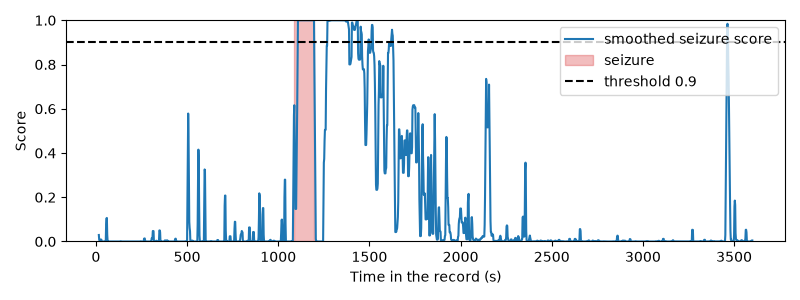
A higher threshold keeps fewer alarm windows: it trades false alarms for missed seizures. The numbers come from one seed, three seizures and three hours of one patient, so they only illustrate the scoring.
Look at one record#
The plot shows the smoothed score of chb05_13 with the seizure shaded.
import matplotlib.pyplot as plt

starts, score = scores["chb05_13"]
onset, offset, _ = TEST["chb05_13"]
fig, ax = plt.subplots(figsize=(8, 3))
ax.plot(starts + WINDOW_S, score, label="smoothed seizure score")
ax.axvspan(onset, offset, color="tab:red", alpha=0.3, label="seizure")
ax.axhline(0.9, color="k", linestyle="--", label="threshold 0.9")
ax.set(xlabel="Time in the record (s)", ylabel="Score", ylim=(0, 1))
ax.legend(loc="upper right")
fig.tight_layout()
plt.show()
References#
Total running time of the script: (0 minutes 31.724 seconds)
Run this example
