Sleep staging on the Sleep Physionet dataset using U-Sleep network#

Note

Please take a look at the simpler sleep staging example Sleep staging on the Sleep Physionet dataset using Chambon2018 network before going through this example. The current example uses a more complex architecture and a sequence-to-sequence (seq2seq) approach.

This tutorial shows how to train and test a sleep staging neural network with Braindecode. We adapt the U-Sleep approach of [1] to learn on sequences of EEG windows using the openly accessible Sleep Physionet dataset [2] [3].

# Authors: Theo Gnassounou <theo.gnassounou@inria.fr>
#          Omar Chehab <l-emir-omar.chehab@inria.fr>
#
# License: BSD (3-clause)

Loading and preprocessing the dataset#

Loading#

First, we load the data using the braindecode.datasets.sleep_physionet.SleepPhysionet class. We load two recordings from two different individuals: we will use the first one to train our network and the second one to evaluate performance (as in the MNE sleep staging example).

from braindecode.datasets import SleepPhysionet

subject_ids = [0, 1]
crop = (0, 30 * 400)  # we only keep 400 windows of 30s to speed example
dataset = SleepPhysionet(
    subject_ids=subject_ids, recording_ids=[2], crop_wake_mins=30, crop=crop
)

Preprocessing#

Next, we preprocess the raw data. We scale each channel recording-wise to have zero median and unit interquartile range. We don’t upsample to 128 Hz as done in [1] so that we keep the example as light as possible. No filtering is described in [1].

from sklearn.preprocessing import robust_scale

from braindecode.preprocessing import Preprocessor, preprocess

preprocessors = [Preprocessor(robust_scale, channel_wise=True)]

# Transform the data
preprocess(dataset, preprocessors)
BaseConcatDataset
TypeBaseConcatDataset of RawDataset
Recordings2
Total samples2400002
Sfreq*100.0 Hz
Channels*2 (2 EEG)
Ch. names*Fpz-Cz, Pz-Oz
Duration*12000.0 s
* from first recording
Description2 recordings × 2 columns [subject, recording]


Extract windows#

We extract 30-s windows to be used in the classification task.

from braindecode.preprocessing import create_windows_from_events

mapping = {  # We merge stages 3 and 4 following AASM standards.
    "Sleep stage W": 0,
    "Sleep stage 1": 1,
    "Sleep stage 2": 2,
    "Sleep stage 3": 3,
    "Sleep stage 4": 3,
    "Sleep stage R": 4,
}

window_size_s = 30
sfreq = 100
window_size_samples = window_size_s * sfreq

windows_dataset = create_windows_from_events(
    dataset,
    trial_start_offset_samples=0,
    trial_stop_offset_samples=0,
    window_size_samples=window_size_samples,
    window_stride_samples=window_size_samples,
    preload=True,
    mapping=mapping,
)

Split dataset into train and valid#

We split the dataset into training and validation set taking every other subject as train or valid.

split_ids = dict(train=subject_ids[::2], valid=subject_ids[1::2])
splits = windows_dataset.split(split_ids)
train_set, valid_set = splits["train"], splits["valid"]

Create sequence samplers#

Following the sequence-to-sequence approach of [1], we need to provide our neural network with sequences of windows. We can achieve this by defining Sampler objects that return sequences of windows. Non-overlapping sequences of 35 windows are used in [1], however to limit the memory requirements for this example we use shorter sequences of 3 windows.

from braindecode.samplers import SequenceSampler

n_windows = 3  # Sequences of 3 consecutive windows; originally 35 in paper
n_windows_stride = 3  # Non-overlapping sequences

train_sampler = SequenceSampler(
    train_set.get_metadata(), n_windows, n_windows_stride, randomize=True
)
valid_sampler = SequenceSampler(valid_set.get_metadata(), n_windows, n_windows_stride)

# Print number of examples per class
print(len(train_sampler))
print(len(valid_sampler))
133
133

Finally, since some sleep stages appear a lot more often than others (e.g. most of the night is spent in the N2 stage), the classes are imbalanced. To avoid overfitting to the more frequent classes, we compute weights that we will provide to the loss function when training.

import numpy as np
from sklearn.utils import compute_class_weight

y_train = [train_set[idx][1][1] for idx in train_sampler]
class_weights = compute_class_weight("balanced", classes=np.unique(y_train), y=y_train)

Create model#

We can now create the deep learning model. In this tutorial, we use the U-Sleep architecture introduced in [1], which is fully convolutional neural network.

import torch

from braindecode.models import USleep
from braindecode.util import set_random_seeds

cuda = torch.cuda.is_available()  # check if CUDA is available
mps = hasattr(torch.backends, "mps") and torch.backends.mps.is_available()
device = "cuda" if cuda else "mps" if mps else "cpu"
if cuda:
    torch.backends.cudnn.benchmark = True
# Set random seed to be able to roughly reproduce results
# Note that with cudnn benchmark set to True, GPU indeterminism
# may still make results substantially different between runs.
# To obtain more consistent results at the cost of increased computation time,
# you can set `cudnn_benchmark=False` in `set_random_seeds`
# or remove `torch.backends.cudnn.benchmark = True`
set_random_seeds(seed=31, cuda=cuda)

n_classes = 5
classes = list(range(n_classes))
# Extract number of channels and time steps from dataset
in_chans, input_size_samples = train_set[0][0].shape
model = USleep(
    n_chans=in_chans,
    sfreq=sfreq,
    depth=12,
    with_skip_connection=True,
    n_outputs=n_classes,
    n_times=input_size_samples,
)

# Send model to the selected accelerator
if device != "cpu":
    model.to(device)

Training#

We can now train our network. braindecode.classifier.EEGClassifier is a braindecode object that is responsible for managing the training of neural networks. It inherits from skorch.classifier.NeuralNetClassifier, so the training logic is the same as in skorch.

Note

We use different hyperparameters from [1], as these hyperparameters were optimized on different datasets and with a different number of recordings. Generally speaking, it is recommended to perform hyperparameter optimization if reusing this code on a different dataset or with more recordings.

from skorch.callbacks import EarlyStopping, EpochScoring
from skorch.helper import predefined_split

from braindecode import EEGClassifier

lr = 1e-3
batch_size = 32
n_epochs = 3

from sklearn.metrics import balanced_accuracy_score


def balanced_accuracy_multi(model, X, y):
    y_pred = model.predict(X)
    return balanced_accuracy_score(y.flatten(), y_pred.flatten())


train_bal_acc = EpochScoring(
    scoring=balanced_accuracy_multi,
    on_train=True,
    name="train_bal_acc",
    lower_is_better=False,
)
valid_bal_acc = EpochScoring(
    scoring=balanced_accuracy_multi,
    on_train=False,
    name="valid_bal_acc",
    lower_is_better=False,
)
callbacks = [
    ("train_bal_acc", train_bal_acc),
    ("valid_bal_acc", valid_bal_acc),
    ("early_stopping", EarlyStopping(patience=10, load_best=True)),
]

clf = EEGClassifier(
    model,
    criterion=torch.nn.CrossEntropyLoss,
    criterion__weight=torch.Tensor(class_weights).to(device),
    optimizer=torch.optim.Adam,
    iterator_train__shuffle=False,
    iterator_train__sampler=train_sampler,
    iterator_valid__sampler=valid_sampler,
    train_split=predefined_split(valid_set),  # using valid_set for validation
    optimizer__lr=lr,
    batch_size=batch_size,
    callbacks=callbacks,
    device=device,
    classes=classes,
)
# Deactivate the default valid_acc callback:
clf.set_params(callbacks__valid_acc=None)

# Model training for a specified number of epochs. `y` is None as it is
# already supplied in the dataset.
clf.fit(train_set, y=None, epochs=n_epochs)
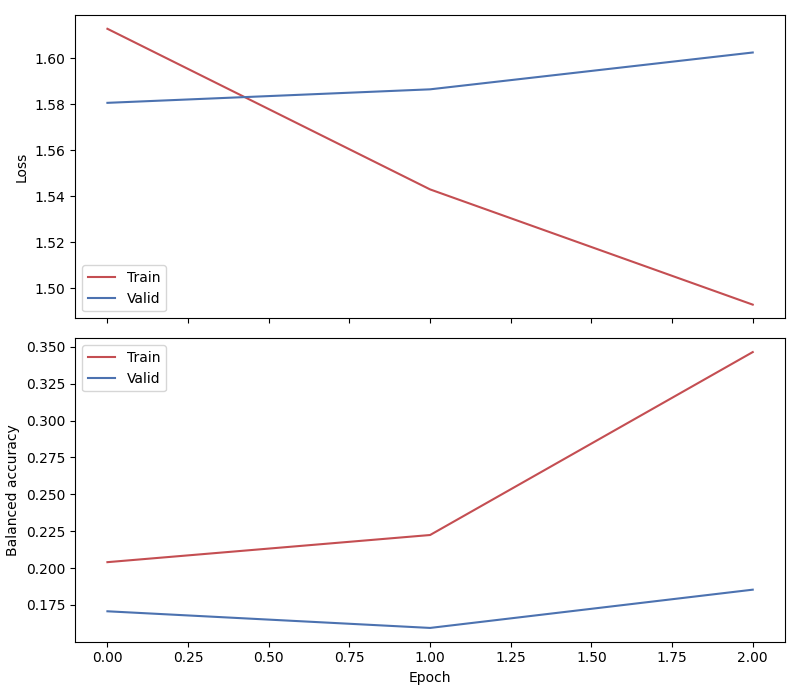
  epoch    train_bal_acc    train_loss    valid_bal_acc    valid_loss     dur
-------  ---------------  ------------  ---------------  ------------  ------
      1           0.2040        1.6129           0.1707        1.5807  2.3440
      2           0.2224        1.5430           0.1594        1.5866  1.8204
      3           0.3464        1.4928           0.1853        1.6026  1.8257
Restoring best model from epoch 1.
<class 'braindecode.classifier.EEGClassifier'>[initialized](
  module_=======================================================================================================================================================
  Layer (type (var_name):depth-idx)                  Input Shape               Output Shape              Param #                   Kernel Shape
  ======================================================================================================================================================
  USleep (USleep)                                    [1, 2, 3000]              [1, 5]                    --                        --
  ├─ModuleList (encoder_blocks): 1-1                 --                        --                        --                        --
  │    └─_EncoderBlock (0): 2-1                      [1, 2, 3000]              [1, 6, 1500]              --                        7
  │    │    └─Sequential (block_prepool): 3-1        [1, 2, 3000]              [1, 6, 3000]              102                       --
  │    │    └─MaxPool1d (maxpool): 3-2               [1, 6, 3000]              [1, 6, 1500]              --                        2
  │    └─_EncoderBlock (1): 2-2                      [1, 6, 1500]              [1, 9, 750]               --                        7
  │    │    └─Sequential (block_prepool): 3-3        [1, 6, 1500]              [1, 9, 1500]              405                       --
  │    │    └─MaxPool1d (maxpool): 3-4               [1, 9, 1500]              [1, 9, 750]               --                        2
  │    └─_EncoderBlock (2): 2-3                      [1, 9, 750]               [1, 11, 375]              --                        7
  │    │    └─Sequential (block_prepool): 3-5        [1, 9, 750]               [1, 11, 750]              726                       --
  │    │    └─MaxPool1d (maxpool): 3-6               [1, 11, 750]              [1, 11, 375]              --                        2
  │    └─_EncoderBlock (3): 2-4                      [1, 11, 375]              [1, 15, 188]              --                        7
  │    │    └─Sequential (block_prepool): 3-7        [1, 11, 375]              [1, 15, 375]              1,200                     --
  │    │    └─ConstantPad1d (pad): 3-8               [1, 15, 375]              [1, 15, 377]              --                        --
  │    │    └─MaxPool1d (maxpool): 3-9               [1, 15, 377]              [1, 15, 188]              --                        2
  │    └─_EncoderBlock (4): 2-5                      [1, 15, 188]              [1, 20, 94]               --                        7
  │    │    └─Sequential (block_prepool): 3-10       [1, 15, 188]              [1, 20, 188]              2,160                     --
  │    │    └─MaxPool1d (maxpool): 3-11              [1, 20, 188]              [1, 20, 94]               --                        2
  │    └─_EncoderBlock (5): 2-6                      [1, 20, 94]               [1, 28, 47]               --                        7
  │    │    └─Sequential (block_prepool): 3-12       [1, 20, 94]               [1, 28, 94]               4,004                     --
  │    │    └─MaxPool1d (maxpool): 3-13              [1, 28, 94]               [1, 28, 47]               --                        2
  │    └─_EncoderBlock (6): 2-7                      [1, 28, 47]               [1, 40, 24]               --                        7
  │    │    └─Sequential (block_prepool): 3-14       [1, 28, 47]               [1, 40, 47]               7,960                     --
  │    │    └─ConstantPad1d (pad): 3-15              [1, 40, 47]               [1, 40, 49]               --                        --
  │    │    └─MaxPool1d (maxpool): 3-16              [1, 40, 49]               [1, 40, 24]               --                        2
  │    └─_EncoderBlock (7): 2-8                      [1, 40, 24]               [1, 55, 12]               --                        7
  │    │    └─Sequential (block_prepool): 3-17       [1, 40, 24]               [1, 55, 24]               15,565                    --
  │    │    └─MaxPool1d (maxpool): 3-18              [1, 55, 24]               [1, 55, 12]               --                        2
  │    └─_EncoderBlock (8): 2-9                      [1, 55, 12]               [1, 77, 6]                --                        7
  │    │    └─Sequential (block_prepool): 3-19       [1, 55, 12]               [1, 77, 12]               29,876                    --
  │    │    └─MaxPool1d (maxpool): 3-20              [1, 77, 12]               [1, 77, 6]                --                        2
  │    └─_EncoderBlock (9): 2-10                     [1, 77, 6]                [1, 108, 3]               --                        7
  │    │    └─Sequential (block_prepool): 3-21       [1, 77, 6]                [1, 108, 6]               58,536                    --
  │    │    └─MaxPool1d (maxpool): 3-22              [1, 108, 6]               [1, 108, 3]               --                        2
  │    └─_EncoderBlock (10): 2-11                    [1, 108, 3]               [1, 152, 2]               --                        7
  │    │    └─Sequential (block_prepool): 3-23       [1, 108, 3]               [1, 152, 3]               115,368                   --
  │    │    └─ConstantPad1d (pad): 3-24              [1, 152, 3]               [1, 152, 5]               --                        --
  │    │    └─MaxPool1d (maxpool): 3-25              [1, 152, 5]               [1, 152, 2]               --                        2
  │    └─_EncoderBlock (11): 2-12                    [1, 152, 2]               [1, 214, 1]               --                        7
  │    │    └─Sequential (block_prepool): 3-26       [1, 152, 2]               [1, 214, 2]               228,338                   --
  │    │    └─MaxPool1d (maxpool): 3-27              [1, 214, 2]               [1, 214, 1]               --                        2
  ├─Sequential (bottom): 1-2                         [1, 214, 1]               [1, 302, 1]               --                        --
  │    └─Conv1d (0): 2-13                            [1, 214, 1]               [1, 302, 1]               452,698                   [7]
  │    └─ELU (1): 2-14                               [1, 302, 1]               [1, 302, 1]               --                        --
  │    └─BatchNorm1d (2): 2-15                       [1, 302, 1]               [1, 302, 1]               604                       --
  ├─ModuleList (decoder_blocks): 1-3                 --                        --                        --                        --
  │    └─_DecoderBlock (0): 2-16                     [1, 302, 1]               [1, 214, 2]               --                        7
  │    │    └─Sequential (block_preskip): 3-28       [1, 302, 1]               [1, 214, 2]               129,898                   --
  │    │    └─Sequential (block_postskip): 3-29      [1, 428, 2]               [1, 214, 2]               641,786                   --
  │    └─_DecoderBlock (1): 2-17                     [1, 214, 2]               [1, 152, 3]               --                        7
  │    │    └─Sequential (block_preskip): 3-30       [1, 214, 2]               [1, 152, 4]               65,512                    --
  │    │    └─Sequential (block_postskip): 3-31      [1, 304, 3]               [1, 152, 3]               323,912                   --
  │    └─_DecoderBlock (2): 2-18                     [1, 152, 3]               [1, 108, 6]               --                        7
  │    │    └─Sequential (block_preskip): 3-32       [1, 152, 3]               [1, 108, 6]               33,156                    --
  │    │    └─Sequential (block_postskip): 3-33      [1, 216, 6]               [1, 108, 6]               163,620                   --
  │    └─_DecoderBlock (3): 2-19                     [1, 108, 6]               [1, 77, 12]               --                        7
  │    │    └─Sequential (block_preskip): 3-34       [1, 108, 6]               [1, 77, 12]               16,863                    --
  │    │    └─Sequential (block_postskip): 3-35      [1, 154, 12]              [1, 77, 12]               83,237                    --
  │    └─_DecoderBlock (4): 2-20                     [1, 77, 12]               [1, 55, 24]               --                        7
  │    │    └─Sequential (block_preskip): 3-36       [1, 77, 12]               [1, 55, 24]               8,635                     --
  │    │    └─Sequential (block_postskip): 3-37      [1, 110, 24]              [1, 55, 24]               42,515                    --
  │    └─_DecoderBlock (5): 2-21                     [1, 55, 24]               [1, 40, 47]               --                        7
  │    │    └─Sequential (block_preskip): 3-38       [1, 55, 24]               [1, 40, 48]               4,520                     --
  │    │    └─Sequential (block_postskip): 3-39      [1, 80, 47]               [1, 40, 47]               22,520                    --
  │    └─_DecoderBlock (6): 2-22                     [1, 40, 47]               [1, 28, 94]               --                        7
  │    │    └─Sequential (block_preskip): 3-40       [1, 40, 47]               [1, 28, 94]               2,324                     --
  │    │    └─Sequential (block_postskip): 3-41      [1, 56, 94]               [1, 28, 94]               11,060                    --
  │    └─_DecoderBlock (7): 2-23                     [1, 28, 94]               [1, 20, 188]              --                        7
  │    │    └─Sequential (block_preskip): 3-42       [1, 28, 94]               [1, 20, 188]              1,180                     --
  │    │    └─Sequential (block_postskip): 3-43      [1, 40, 188]              [1, 20, 188]              5,660                     --
  │    └─_DecoderBlock (8): 2-24                     [1, 20, 188]              [1, 15, 375]              --                        7
  │    │    └─Sequential (block_preskip): 3-44       [1, 20, 188]              [1, 15, 376]              645                       --
  │    │    └─Sequential (block_postskip): 3-45      [1, 30, 375]              [1, 15, 375]              3,195                     --
  │    └─_DecoderBlock (9): 2-25                     [1, 15, 375]              [1, 11, 750]              --                        7
  │    │    └─Sequential (block_preskip): 3-46       [1, 15, 375]              [1, 11, 750]              363                       --
  │    │    └─Sequential (block_postskip): 3-47      [1, 22, 750]              [1, 11, 750]              1,727                     --
  │    └─_DecoderBlock (10): 2-26                    [1, 11, 750]              [1, 9, 1500]              --                        7
  │    │    └─Sequential (block_preskip): 3-48       [1, 11, 750]              [1, 9, 1500]              225                       --
  │    │    └─Sequential (block_postskip): 3-49      [1, 18, 1500]             [1, 9, 1500]              1,161                     --
  │    └─_DecoderBlock (11): 2-27                    [1, 9, 1500]              [1, 6, 3000]              --                        7
  │    │    └─Sequential (block_preskip): 3-50       [1, 9, 1500]              [1, 6, 3000]              126                       --
  │    │    └─Sequential (block_postskip): 3-51      [1, 12, 3000]             [1, 6, 3000]              522                       --
  ├─Sequential (clf): 1-4                            [1, 6, 3000]              [1, 6, 1]                 --                        --
  │    └─Conv1d (0): 2-28                            [1, 6, 3000]              [1, 6, 3000]              42                        [1]
  │    └─Tanh (1): 2-29                              [1, 6, 3000]              [1, 6, 3000]              --                        --
  │    └─AvgPool1d (2): 2-30                         [1, 6, 3000]              [1, 6, 1]                 --                        [3000]
  ├─Sequential (final_layer): 1-5                    [1, 6, 1]                 [1, 5, 1]                 --                        --
  │    └─Conv1d (0): 2-31                            [1, 6, 1]                 [1, 5, 1]                 35                        [1]
  │    └─ELU (1): 2-32                               [1, 5, 1]                 [1, 5, 1]                 --                        --
  │    └─Conv1d (2): 2-33                            [1, 5, 1]                 [1, 5, 1]                 30                        [1]
  │    └─Identity (3): 2-34                          [1, 5, 1]                 [1, 5, 1]                 --                        --
  ======================================================================================================================================================
  Total params: 2,482,011
  Trainable params: 2,482,011
  Non-trainable params: 0
  Total mult-adds (Units.MEGABYTES): 22.43
  ======================================================================================================================================================
  Input size (MB): 0.02
  Forward/backward pass size (MB): 2.91
  Params size (MB): 9.93
  Estimated Total Size (MB): 12.86
  ======================================================================================================================================================,
)
In a Jupyter environment, please rerun this cell to show the HTML representation or trust the notebook.
On GitHub, the HTML representation is unable to render, please try loading this page with nbviewer.org.


Training for longer#

The gallery build above uses only n_epochs = 3. When trained offline for up to 100 epochs with early stopping, the model reaches 30.4 % balanced accuracy on the held-out recording (chance = 20 %).

We can load the pretrained checkpoint from the Hugging Face Hub and inspect the full training curves:

import warnings

repo_id = "braindecode/plot_sleep_staging_usleep"
try:
    from huggingface_hub import hf_hub_download

    clf.initialize()
    clf.load_params(
        f_params=hf_hub_download(repo_id, "params.safetensors"),
        f_history=hf_hub_download(repo_id, "history.json"),
        use_safetensors=True,
    )
except Exception as exc:
    warnings.warn(
        f"Could not load pretrained checkpoint from {repo_id} ({exc}); "
        "continuing with the locally trained short-run model.",
        stacklevel=2,
    )
Re-initializing module.
Re-initializing criterion because the following parameters were re-set: weight.
Re-initializing optimizer.

Plot training curves#

import matplotlib.pyplot as plt
import pandas as pd

df = pd.DataFrame(clf.history.to_list())
df.index.name = "Epoch"
fig, (ax1, ax2) = plt.subplots(2, 1, figsize=(8, 7), sharex=True)
df[["train_loss", "valid_loss"]].plot(color=["r", "b"], ax=ax1)
df[["train_bal_acc", "valid_bal_acc"]].plot(color=["r", "b"], ax=ax2)
ax1.set_ylabel("Loss")
ax2.set_ylabel("Balanced accuracy")
ax1.legend(["Train", "Valid"])
ax2.legend(["Train", "Valid"])
ax1.grid(alpha=0.3)
ax2.grid(alpha=0.3)
fig.tight_layout()
plt.show()
plot sleep staging usleep

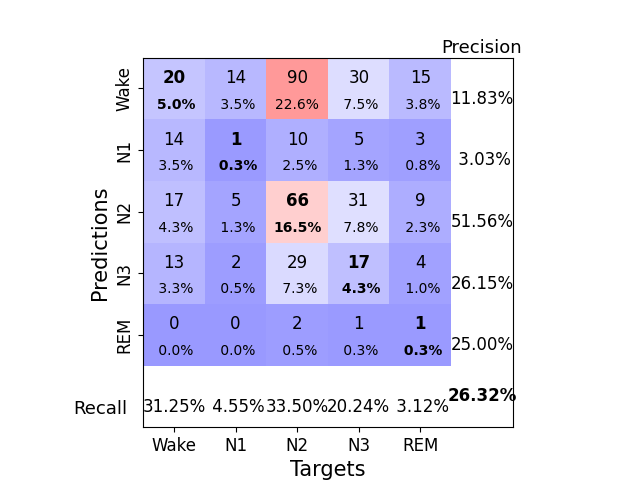
Finally, we also display the confusion matrix and classification report:

from sklearn.metrics import ConfusionMatrixDisplay, classification_report

y_true = np.array([valid_set[i][1] for i in valid_sampler])
y_pred = clf.predict(valid_set)

ConfusionMatrixDisplay.from_predictions(
    y_true.flatten(),
    y_pred.flatten(),
    labels=[0, 1, 2, 3, 4],
    display_labels=["Wake", "N1", "N2", "N3", "REM"],
)

print(classification_report(y_true.flatten(), y_pred.flatten()))
plot sleep staging usleep
              precision    recall  f1-score   support

           0       0.20      0.20      0.20        64
           1       0.09      0.14      0.11        22
           2       0.59      0.47      0.52       197
           3       0.21      0.21      0.21        84
           4       0.18      0.34      0.24        32

    accuracy                           0.34       399
   macro avg       0.26      0.27      0.26       399
weighted avg       0.39      0.34      0.36       399

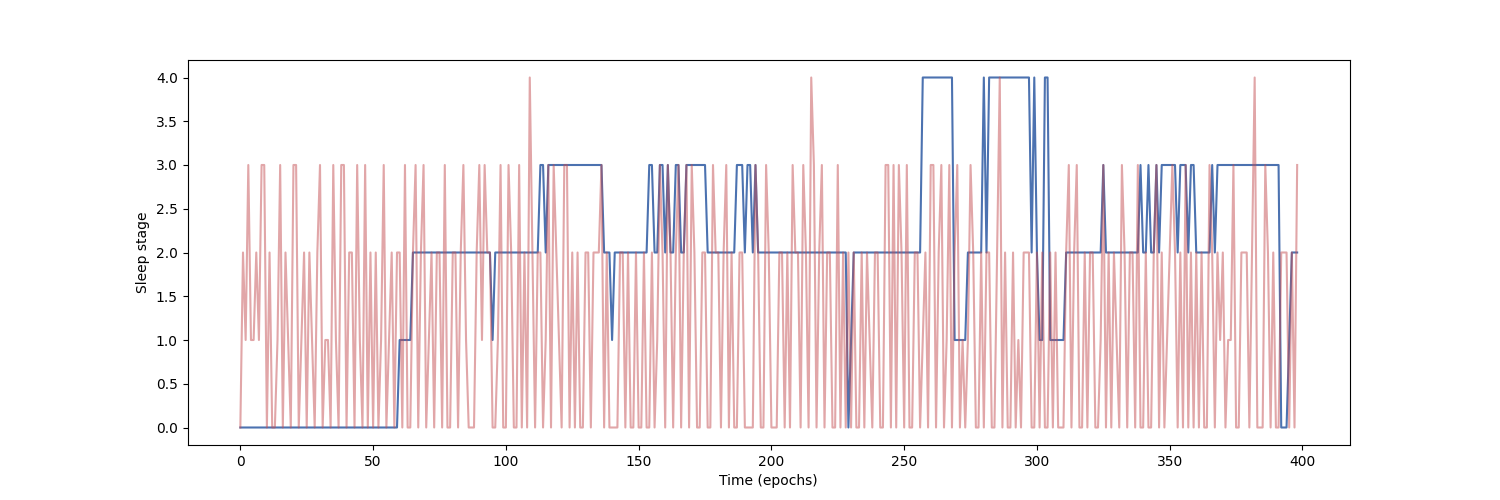
Finally, we can also visualize the hypnogram of the recording we used for validation, with the predicted sleep stages overlaid on top of the true sleep stages. We can see that the model cannot correctly identify the different sleep stages with this amount of training.

import matplotlib.pyplot as plt

fig, ax = plt.subplots(figsize=(15, 5))
ax.plot(y_true.flatten(), color="b", label="Expert annotations")
ax.plot(y_pred.flatten(), color="r", label="Predict annotations", alpha=0.5)
ax.set_xlabel("Time (epochs)")
ax.set_ylabel("Sleep stage")
plot sleep staging usleep
Text(150.22222222222223, 0.5, 'Sleep stage')

References#

Total running time of the script: (0 minutes 17.389 seconds)

Estimated memory usage: 859 MB

Gallery generated by Sphinx-Gallery